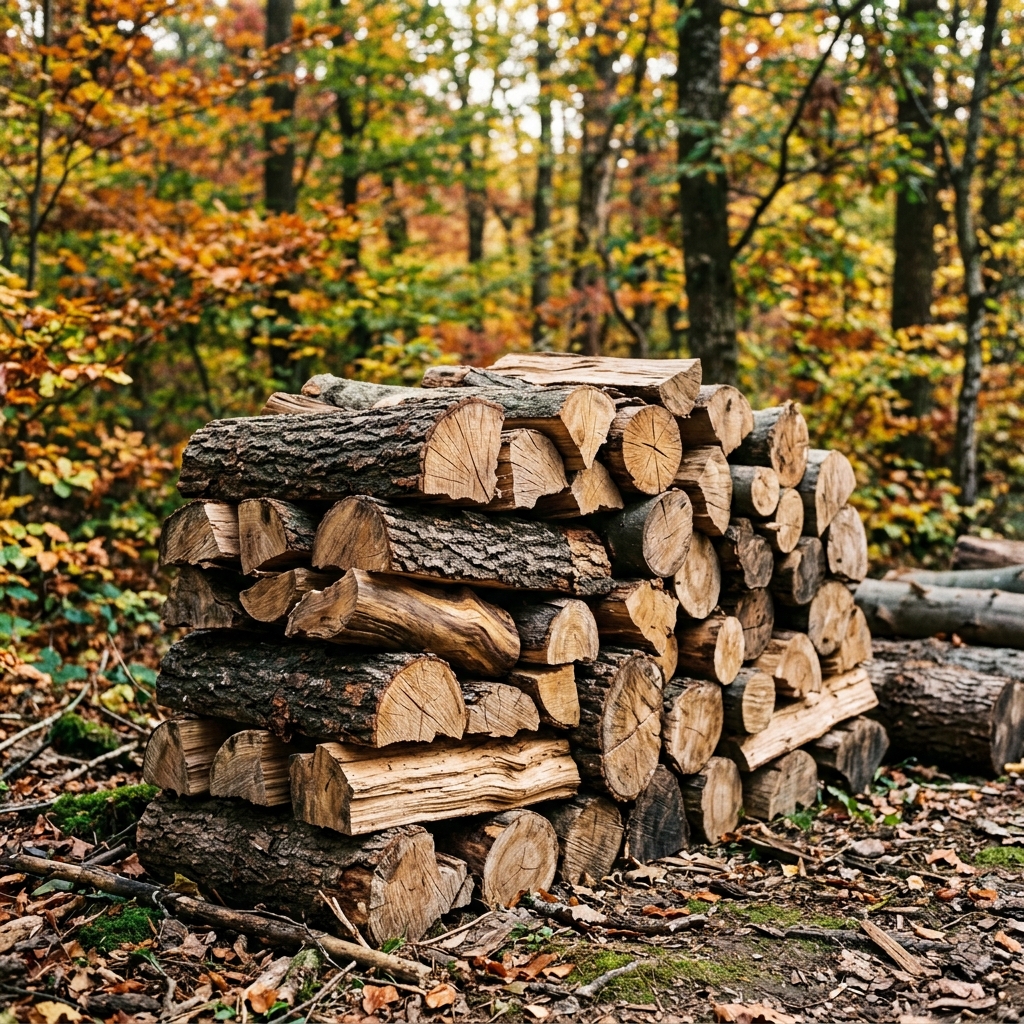
The fuel for your chimney is, of course, wood. However, a very common mistake among users is assuming that all firewood burns the same. Buying the cheapest wood without knowing its origin or burning wet pruning remains can reduce your chimney's heating capacity by more than 50% and **multiply the accumulation of soot and flammable creosote tenfold**.
In this guide, we carry out a technical analysis of the different types of firewood common in our region (Catalonia and Castellón) to help you choose the wood that heats the most and keeps your flue clean for longer.
Hardwood vs. Softwood
Wood is classified into two large groups based on its density and forest origin:
- Hardwoods (Recommended): They come from slow-growing and deciduous trees (holm oak, olive, oak, almond). These woods are very dense and heavy. They burn slowly, generate constant and long-lasting heat, and produce exceptional embers. By burning very cleanly, they generate very few residues in the flue.
- Softwoods (For starting only): They come from conifers and fast-growing trees (pine, fir, poplar). They are light and porous. They burn very quickly, producing spectacular but short-lived flares and do not generate useful embers. Worst of all, they contain **high levels of resin** which, when burned, release dense, black soot that clogs the pipes.
"Only use pine firewood in small kindling chips to start the initial fire. Once you have embers, feed the chimney exclusively with hardwoods."
Comparison of the Best Firewoods
These are the most popular and efficient commercial hardwood varieties:
- Holm Oak Firewood (The queen of firewood): It is the ultimate firewood. Its density is extremely high, making it burn very slowly (a thick log can last for hours). It produces long-lasting embers and radiant heat. It barely generates smoke or dirties the chimney glass. Its only drawback is that it is harder to light.
- Olive Firewood: Highly abundant in Tarragona and Castellón. It has an extraordinary heating power and produces a lively and visually pleasing flame. It is excellent to insert in the fireplace cassette when you want to heat the room quickly. It produces very little resin.
- Oak Firewood: Similar in characteristics to holm oak. It offers a very stable and long-lasting fire. It requires the chimney to already have a good internal temperature to burn optimally, but its heat output is unbeatable for harsh winters.
Moisture: The Most Destructive Factor
You can buy the best holm oak firewood on the market, but if it is wet, it will ruin your chimney. Freshly cut firewood contains up to **50% water**.
When burning wet firewood, most of the fire's energy is wasted evaporating the internal water instead of heating your home. This causes incomplete combustion at low temperatures, generating thick, cold smoke loaded with acidic water droplets and tar. This mixture solidifies on the flue walls, forming dangerous **glazed creosote**.
Comparison Table of Commercial Firewood
| Firewood Species | Heating Power | Burning Speed | Residue Level | Optimal Use |
|---|---|---|---|---|
| Holm Oak | Excellent (Very high) | Very slow | Very low | Continuous heating and long-lasting embers. |
| Olive | Excellent (High) | Medium-Slow | Low | Lively fires and fast heat. |
| Oak | Very Good | Very slow | Low | Maintaining heat overnight. |
| Pine | Medium-Low | Very fast | Very High (Resin) | Only for starting the fire. |
How to know if the firewood is well seasoned
A well-seasoned log (moisture < 20%) weighs considerably less than a wet one, has cracks at the ends of the cuts, the bark comes off easily, and when striking two logs together, they produce a clear, dry sound (bell-like), not a dull, damp thud.
Conclusion
Investing in dry holm oak or olive firewood is the most economical decision in the long run: it heats twice as much, you consume half as many logs, and **you avoid clogs and fires in the flue**.
Remember to store your firewood in a dry, ventilated place protected from direct rain all year round to ensure that when the cold starts, your chimney performs at 100%.