In any department store, supermarket, or hardware store, it is common to find a wide range of products designed for DIY chimney cleaning: bags of catalytic powder, chemical cartridges, and, above all, the famous **creosote logs**. Their labels promise convenient and economical cleaning just by lighting them.
But are they really effective? Can they replace the work of a professional chimney sweep equipped with wire brushes? In this article, we analyze the technical truth behind **chemical versus mechanical chimney sweeping**.
How does chemical chimney sweeping work?
Creosote logs and catalytic powders are composed of chemical additives (metallic salts and copper compounds) integrated into a compacted sawdust base.
When burned in the fireplace, these components release a smoke loaded with chemicals that come into contact with the creosote accumulated on the walls of the flue. The chemical reaction causes the wet, sticky resin to dehydrate, crystallizing and becoming brittle, which in theory makes it easier to flake off and fall.
"A creosote log is a chemical softener, not an extractor. It modifies the consistency of the creosote so that it is easier to brush, but by itself, it does not clean the chimney."
The dangers and limitations of chemical logs
Although chemical chimney sweeps have their uses, employing them as the sole cleaning method presents serious drawbacks and dangers:
- Danger of bottom blockage (clogging): As it dries and detaches, the creosote crust falls by gravity. If the flue has any bends or if the stove has an upper smoke deflector, the hard pieces of tar will accumulate there, creating a clog that will block the smoke outlet and generate an **imminent risk of toxic gas backdraft or a localized fire**.
- Inability to remove large crusts: Thick vitrified creosote (Stage 3) is impenetrable to catalytic smoke in a single application.
- Cannot detect nests or cracks: A chemical product burned in the firebox will not tell you if there is a bird's nest blocking the flue, if the steel pipe is corroded, or if the refractory joints are cracked.
Mechanical chimney sweeping: The professional standard
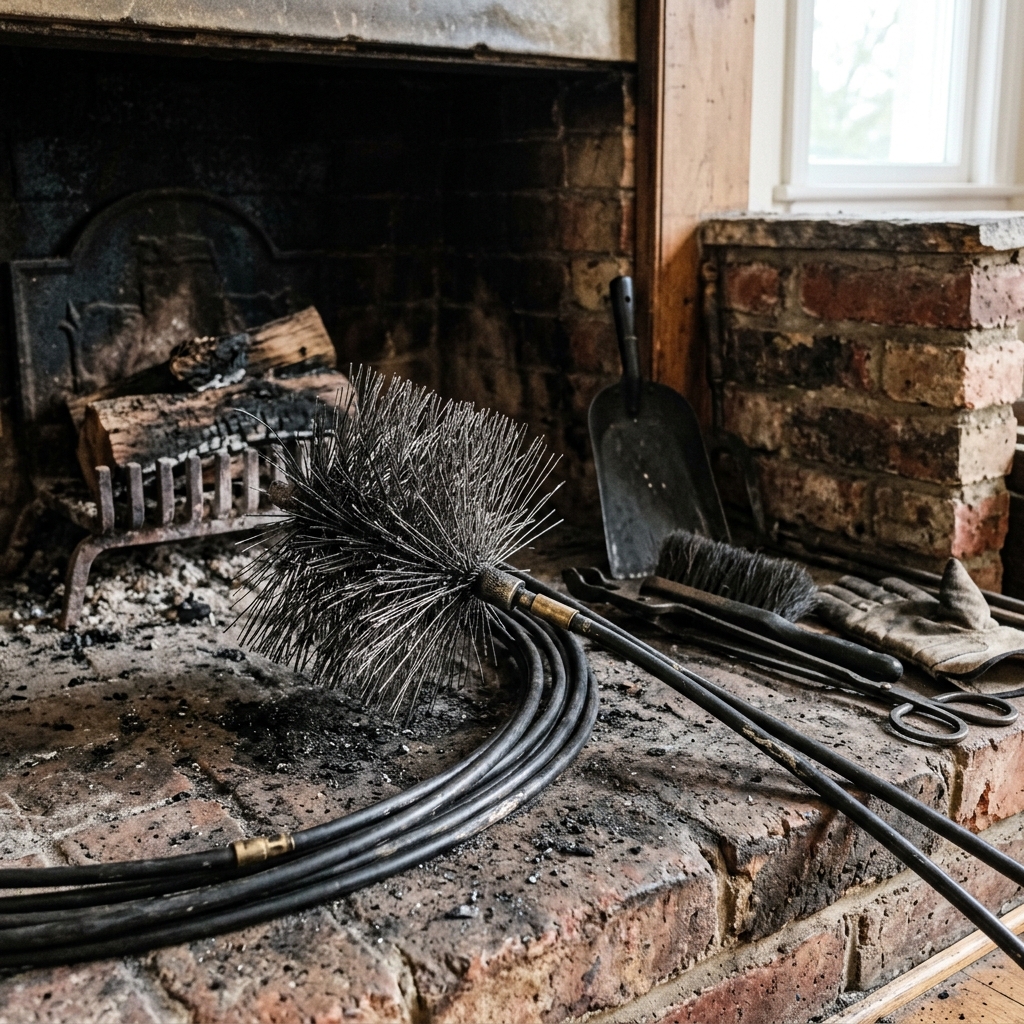
Mechanical chimney sweeping is the traditional method and the only one guaranteed by professionals. It consists of inserting connectable flexible rods topped with a brush (called a flue brush) sized exactly to the diameter and material of the pipe (steel, stainless steel, brick masonry, or clay).
Through physical scrubbing, the brush scrapes and detaches all the resin and soot from the walls. Then, the residue is physically extracted from the bottom using high-power industrial vacuums equipped with HEPA filters to avoid making a mess in the home.
Technical comparison table
| Feature | Chemical Log (DIY Cleaning) | Mechanical Brushing (Professional) |
|---|---|---|
| Action mechanism | Catalytic smoke reaction. | Direct physical friction with steel/nylon brush. |
| Residue extraction | None. The soot falls to the bottom or stays in the bends. | Total. It is collected and vacuumed in a controlled manner. |
| Effectiveness on hard creosote | Low. Only weakens it superficially. | High. Scrapes it until the pipe walls are clear. |
| Fire safety | Low. Since soot is not extracted, the danger persists. | Maximum. Removes all flammable material. |
| Insurance Certificate | Not valid. Does not justify technical maintenance. | Yes. A professional service invoice is issued. |
The ideal combination
In chimneys with severe accumulations of glazed creosote, professionals use a preliminary chemical softening treatment (specific powders) a few days before performing the mechanical sweeping to facilitate the release of the most stubborn crusts without damaging the metal duct.
Conclusion
Burning a chemical log can be useful as a **mid-season preventive maintenance treatment** to soften residues, but it **should never replace the annual mechanical chimney sweeping**.
Only physical scrubbing with suitable brushes, executed by an experienced technician, guarantees a completely clear flue, safe from fires and carbon monoxide poisoning, and ready to provide maximum heat to your home.